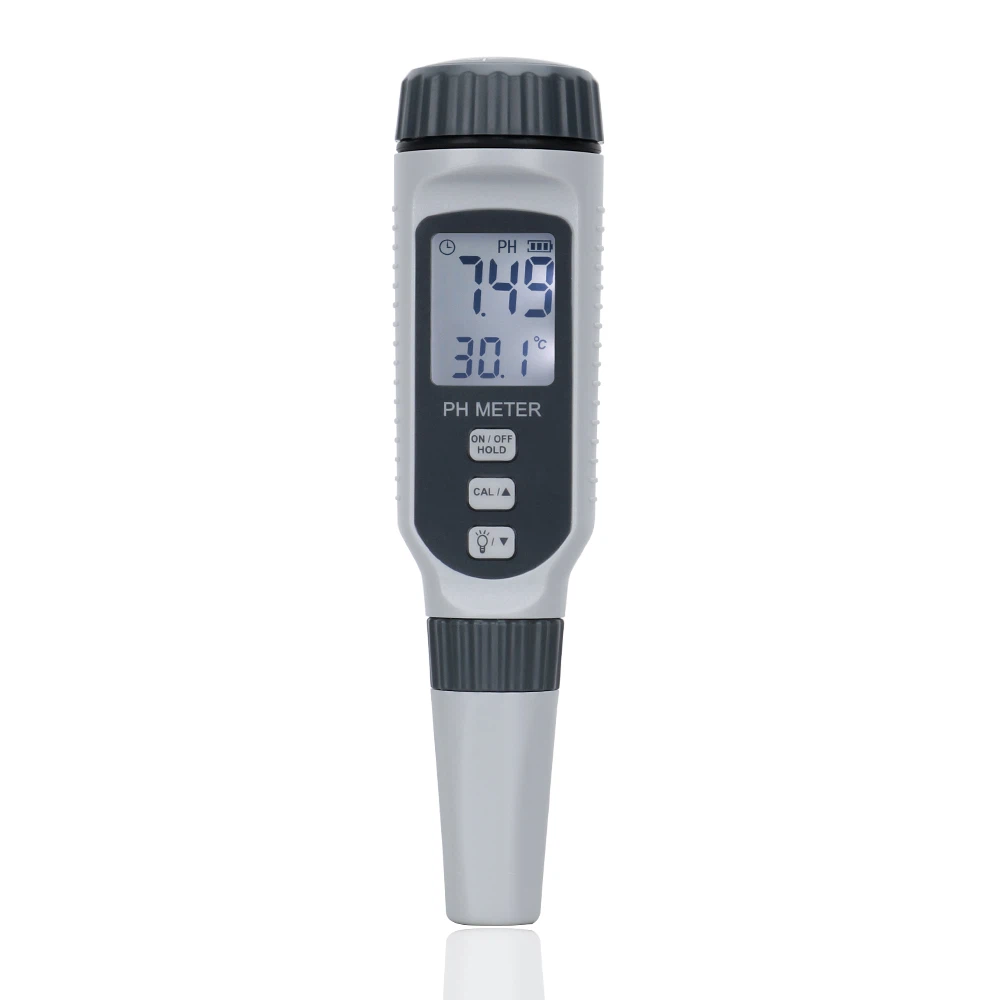
Automatic acid-base titration with pH meter indicating the end point
(1) Purpose of the experiment
(1) Understand the working principle and usage of pH meter. (2) Able to use pH meter for acid-base titration.
(2) Experimental principle
Potentiometric titration is an analytical method that uses a jump in electrode potential to determine an endpoint. In the titration process, with the addition of titrant, due to the chemical reaction in the system, the concentration of the ion to be measured is constantly changing, and the electrode potential of the indicator electrode is also changing continuously. Near the stoichiometric point, the concentration of the ion to be measured suddenly changes Jump, the electrode potential of the indicator electrode also jumps, so as to determine the titration end point. However, it is cumbersome to determine the end point by using the first-order derivative titration curve of ΔE/ΔV versus V or the second-order derivative titration curve of △E2/△V2 versus V. Therefore, the end point is usually determined by automatic potentiometric titration.
In this experiment, 0.1mol/L HCL solution is used to titrate NaOH solution with unknown concentration, and the pH composite electrode is used as the indicator electrode, so that the indicator electrode can convert the change of hydrogen ion concentration (or the change of electrode potential) in the titration system into the change of pH to indicate the end point. When the pH is equal to 7, the automatic titrator stops titration and displays the volume of titrant used. (Explanation: Since the titration is performed automatically by the titrator, the titration speed is relatively slow and takes a long time. Therefore, we use manual titration during the experiment to control the experiment process and improve the efficiency of the experiment.)
(3) Experimental instruments and reagents
ZD{{0}} type automatic potentiometric titrator, 0.1mol/L HCL solution, NaOH solution of unknown concentration, 20ml pipette ear wash ball, magnet, 2 150ml beakers, 1 500ml beaker, filter paper, etc.
(4) Experimental steps
(1) Turn on the power, start the automatic potentiometric titrator, and preheat for 5 minutes.
(2) Cleaning and rinsing of the automatic potentiometric titrator: insert the catheter into the bottle containing distilled water, press the cleaning button, and start cleaning according to the system default cleaning times (3 times); then insert the catheter into the bottle containing 0.1mol/ In the HCL solution of L, press the cleaning button to rinse once; rinse the glass bulb of the pH composite electrode and the cylinder of the temperature sensor with distilled water and dry them with filter paper.
(3) Pipette 20 mL of NaOH solution of unknown concentration into a clean beaker, add a magnet, place it on the electromagnetic stirring place of the automatic potentiometric titrator, add enough distilled water to immerse the glass ball of the pH composite electrode in the solution .
(4) Press the stirring key, and set the stirring speed to 50. Press the titration key to enter the titration mode selection, select manual titration, and press the confirmation key; the slope and potential are defaulted by the system, press the confirmation key; select the pre-added volume and the next dripping volume and set it (the specific value depends on the actual situation), Press the enter key to start titration. After the pre-added volume is added, press the Add button to add. When the pH is close to 7, the added volume should be set as small as possible. When the pH is finally within the range of 7.00±0.05, stop the titration and record the volume of titrant consumed. Repeat the above operation three times.
(5) Rinse the pipeline of the automatic titrator with distilled water three times, and then turn off the instrument. Rinse the pH composite electrode and wipe it dry with filter paper, add saturated KCL solution into the pH composite electrode cover, and insert the pH composite electrode into the cover.
(5) Precautions
The main sensing part of the composite electrode is the bulb of the electrode. The bulb is extremely thin and must not be in contact with hard objects. After the measurement, put on the protective cap, and put a small amount of replenishment solution (3mol/L potassium chloride solution) in the cap to keep the electrode bulb moist.
(6) Data processing
The volume of NaOH is fixed at 20 ml The concentration of hydrochloric acid: 0.1 mol/L